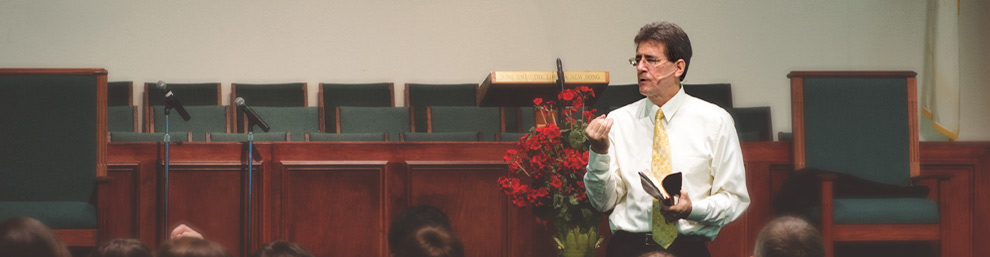
What More Does God Want?

When he had lived 75 years, Abraham was called by God to leave behind all that was familiar to him: home, work, culture, and career. The Lord challenged him to move hundreds of miles and to live as a sojourner in a foreign country. Abraham followed God’s leadership.

God promised to make Abraham into a great nation, but he and his wife Sarah had no children. Years passed and the couple entered their senior years, but God insisted that they would have a son. Abraham believed God’s promise.

God commanded Abraham to be circumcised and to circumcise all the males in his household. This was a sign that he believed God’s promises and entrusted his future into God’s hands. Abraham accepted God’s mark of ownership.

Abraham and Sarah waited 25 years, until she was beyond child-bearing years and he was 100. Finally, God’s promise was fulfilled. They had a son and named him Isaac, which means laughter. Sarah laughed with joy. At last, things seemed to be coming together. Abraham celebrated God’s blessing.

Then God challenged Abraham again. The Lord tested him. He commanded Abraham to take his son, whom he loved, and to sacrifice him on a certain mountain. Isaac, who represented the future of God’s promises to Abraham, would be gone.

How many times did Abraham have to prove his faith to God? After all, he had left his home to live as a stranger in a strange land. He had believed God’s promises and adopted the sign of circumcision. And he had waited for a quarter of a century for his son to be born. What more did God want?

The Lord wanted Abraham’s faith to keep growing. No matter how many years he lived in this world, God kept urging Abraham to reach new heights in his walk with the Lord. God wanted him to have a vital and living faith, content but not complacent, confident but not presumptive.

As he had in the past, Abraham obeyed God. And on that mountain, God provided a substitute sacrifice for Isaac. Abraham gave up his son for the Lord’s sake and as a result he got Isaac back, along with an even stronger and more mature faith. Abraham passed the test.

Only our Lord knows what he has in store for us in 2014. Surely we will enjoy many great times of joy and blessing as God continues to fulfill his promises to us. We may face a test along the way. If we do, we can be certain that the Lord will provide.

May God’s Holy Spirit enable us to soar to new heights and discover greater depth in the faith this year,

Brother Richard Foster

Leave a comment

Filed under religion

Why Christmas Music is so Important

Christmas would still be wonderful without the music, but the songs we hear and sing each year as we celebrate Jesus’ birth really accent the joy of Christmastime.

The Bible urges us to see that the word of Christ dwells richly within us (Colossians 3:16). With all wisdom, it says, we are to teach and instruct ourselves by using psalms, hymns, and spiritual songs. Music is a powerful tool for communicating spiritual truth. Music is not only helpful in learning Christian truth, it is commanded!

This should not be a surprise. In the pages of the New Testament careful students of God’s word have detected the presence of songs from the Early Church. In one place, lyrics from ancient Christian worship express the sweeping magnitude of Christ stepping down from glory to die on a Roman cross only to be exalted again to the highest place (Philippians 2:5-11).

Another apparent worship song appears in the first letter to Timothy:

Beyond all question, the mystery of godliness is great:
  He appeared in a body,
    was vindicated by the Spirit,
    was seen by angels,
    was preached among the nations,
    was believed on in the world,
    was taken up in glory (1 Timothy 3:16, NIV).

The ancient musical terms in Colossians refer to musical styles long forgotten, but one thing is clear: all types of music should be used in Christian teaching. Psalm 33 exhorts us to sing to the Lord a new song (v. 3). The mixture of both established and innovative songs is part of the wonder, reminding us that the one message of all Christmas songs is the real focus, not a particular style of chords, rhythms, and melodies.

The older Christmas carols that we still sing have stood the test of time. They are the cream of the crop, musically, lyrically, and theologically, expressing both the feelings and the thoughts of that silent night in Bethlehem with almost supernatural precision.

New songs that are well-written and performed infuse a fresh sense of wonder into the ancient story about the manger and swaddling clothes, shepherds and angels. The old hymns and the new choruses combine to tell the one profound account of the Word becoming flesh and dwelling among us.

The instruction in Colossians concludes by calling on us to sing with our hearts to God. Some of us may struggle to get the rhythm just right or hit the proper pitch as we sing the songs of Christmas. But the Bible does not mention anything about great musical performances; rather, it asks for something that comes from inside.

Sing the wonderful music of Christmas. Enjoy your favorites. Learn a new song. And may the word of Christ dwell richly within you. Merry Christmas!

Brother Richard

Leave a comment

Filed under religion

The Appointed Time

God promised Abraham and Sarah that they would have a son, but nothing happened. They waited for years, until Sarah was physically unable to bear children and Abraham was closing in on 100 years of age. They remained childless.

Then a miracle happened. The Bible says that God visited Sarah, that is, God enabled her to have a baby with Abraham. More than that, the Bible tells us that God blessed the couple with a son at the very time he had promised (Genesis 21:2).

Some people might think that God was a bit late in blessing Abraham and Sarah, but Scripture assures us that he acted at the appointed time. The boy was named Isaac, which means “he laughs.” Sarah was laughing. She was filled with joy.

Some two thousand years after Isaac was born, God promised a miracle baby to one of Isaac’s descendants. She was a young lady named Mary. She was soon to be married to a man named Joseph.

God promised Mary that she would have a boy before she was married to Joseph, before she and Joseph came together, and without knowing any other man. She was understandably confused.

Sure enough, God’s Spirit visited young Mary and she was carrying a baby. Joseph was stunned. He drew the logical conclusion that Mary had been unfaithful to him. But the Lord spoke to him personally and cleared Mary of any wrongdoing.

Some people might think that God was a bit early in the case of Joseph and Mary. Was he not putting Mary in an awkward position? What would people say? But Scripture assures us that God acted at the appointed time. When the time had fully come, God sent his Son, born of a woman, born under law, to redeem us (Galatians 4:4-5).

God’s great work of salvation started thousands of years ago when he chose a man named Abraham and promised him a son. It seemed impossible, but God does the impossible.

Centuries later a prophet named Isaiah wrote that a virgin would be with child and give birth to a son, calling him Immanuel. It seemed impossible, but it happened. And all who heard it were amazed.

Laugh with Sarah, rejoice with Isaiah, and treasure up all these things in your heart with Mary. Our Savior has come!

Glory to God in the highest, and on earth peace, good will to all,

Brother Richard Foster

1 Comment

Filed under religion

Angels and Demons

In the same way that scientists use telescopes and microscopes to see realities about our world that are invisible to our physical eyes, God’s people can use God’s Word to know things about our world that are invisible as well. And in the same way that unseen physical realities can be either life-saving or life-threatening, unseen spiritual realities can be either a wonderful blessing or a terrible curse.

Very early in the Bible we read about three deadly enemies that operate in the unseen spiritual realm. First, we read that Satan deceived Adam and Eve, convincing them to disobey God. Second, we see that Adam and Eve failed because of their own selfish desires, wanting more than what God provided. Third, creation itself was cursed by God because of Adam and Eve’s disobedience. These three dangerous enemies are also known as the Devil, the flesh, and the world.

God’s people still face these same three enemies today. Satan may be invisible to most people, but he is still leading people astray by planting doubts about God’s Word and about God’s goodness. Selfishness and jealousy still drive people to disobedient and destructive acts. And the world we live in is just as broken now as it was when Cain killed Abel. If we ignore these Bible truths, then we will be misled into fighting the wrong enemies, and the result will be terrible defeat and loss.

The Bible also tells us about invisible realities that are forces for good, enabling us to fight the right battle and to win the real victory. Satan and his demons are not the only supernatural beings in this world. Angels are sent by God to help those who are inheriting eternal life. And God’s Holy Spirit, his invisible, powerful, personal, Presence in the hearts of his people, is also working in the world today. God’s Spirit enables God’s people not only to fight the right battles, but to win the greatest victory.

The Bible helps us to understand the true nature of the world in which we live. By devoting ourselves to God’s Word, we can gain wisdom about the struggle that rages all around us. And not only can we understand the real struggle, we can share in the victory that God is even now bringing about, a victory that will be final and complete when Jesus returns. Let’s gain the understanding that God is making available to us and let’s fight the good fight, keep the faith, and enjoy the crown of righteousness that the Lord will award to all those who long for his appearing.

May God’s Word dwell richly in our hearts and may God’s Spirit empower us to share in his eternal victory over Satan, sin, and death,

Brother Richard

Leave a comment

Filed under religion

Podcast: Freedom of Religion and the Old Testament II

Freedom of Religion in the Old Testament II – Listen

Are our freedoms in the United States of America eroding? If so, in what areas are they eroding? Why? Brother Richard discusses this issue in-depth in this message, “Freedom of Religion in the Old Testament.”

This is the conclusion of a two-part series on freedom of religion and the Old Testament.

Leave a comment

Filed under Podcasts, religion

Podcast: Freedom of Religion and the Old Testament


Freedom of Religion and the Old Testament
– Listen

Freedom of Religion in the Old Testament – Watch

Are our freedoms in the United States of America eroding? If so, in what areas are they eroding? Why? Brother Richard discusses this issue in-depth in this message, “Freedom of Religion in the Old Testament.”

This is the first message in a two-message series.

Leave a comment

Filed under Podcasts, religion

If My People

Why did God visit Abraham on his way to Sodom and Gomorrah? He said that he would go down and see if things were as wicked as it seemed in Sodom. But the God of heaven and earth has no need to “go down and see” in order to know the state of Sodom or any city.

On his way to Sodom, God stopped by the home of Abraham. Abraham looked up and three men stood near his tent in the heat of the day. According to the customs of his day, Abraham was quick to offer gracious hospitality for the men. They accepted his offer of a restful meal.

During the after-dinner talk, Abraham realized that he was not entertaining normal visitors. In some mysterious way, God’s very presence had come to call. And God decided to share his mission with Abraham. He was apparently on a fact-finding trip that would determine the fate of a city and its citizens.

Abraham could have kept quiet and let the Lord go on. After all, what business was it of his? So long as God did not bother Abraham and his household, what good would it do to get involved anyway? God knows what he is doing. Let him go to it.

Or Abraham could have offered his opinion. After all, he lived just a few miles away from the city. He could have told God that what he heard about Sodom was right. It definitely was a desperately wicked city. Abraham could have told God that he would not blame him for sweeping the place away in judgment.

But what Abraham did was simply astounding. He appealed to God for mercy. He asked that God spare the wicked citizens of Sodom. God agreed with Abraham that if just ten righteous people could be found in the city then he would spare everyone. Abraham interceded with God for a corrupt, violent, and immoral people.

True, Abraham’s nephew, Lot, lived in the city. His intercession could have been for selfish reasons. But he did not ask God to save only his kinfolk. He pleaded for God to show mercy on the entire population of Sodom. Abraham appealed to God for undeserved favor.

Abraham’s example of intercession with God is timely for us. By almost every measure imaginable the cities around us are declining rapidly. The most important measure, of course, is spiritual. And the spiritual condition of America is deplorable. We are driving hard and fast toward a truly desperate situation.

We could easily feel overwhelmed by the magnitude of the problem and choose to simply protect our own. We could rightly be angry about the horrible circumstances and just agree that God should wipe out the wicked. But Abraham, the man of faith, offers us a better response: we should intercede with God for America, appealing for his great grace.

America needs godly people to cry out to the Lord for mercy. God our Savior is gracious. He told Abraham that for just ten righteous people he would spare the desperately sinful city of Sodom. Unfortunately for Sodom, not even ten righteous people were left in the place.

We must cry out to God for his grace and mercy before the righteous dwindle away to nothing and it is too late for our communities and neighborhoods. The Lord has promised that when his people, those called by his name, humble themselves and pray, that he will hear and forgive and heal the land. (2 Chronicles 7:14)

May we be found faithful,

Brother Richard

Leave a comment

Filed under religion

A Pleasing Aroma

Jesus expressed his dissatisfaction with the goings-on in the Temple in a dramatic and eye-catching way. He fashioned a whip out of some cords and started driving out those who were buying and selling in the Temple courts. He also overturned the tables of the moneychangers – very aggressive!

Once Jesus had everyone’s attention, he made an announcement about God’s house. He accused the people in the courtyard of turning God’s house into a den of thieves. Of all the sin and disobedience that Jesus observed, why did buying and selling in the Temple courts inspire so much fury from him? Because, he declared, God’s house is meant to be a house of prayer, not a marketplace.

Consider all the things that Jesus could have said about the house of the Lord. He could have said that it was intended to be a place of sacrificing to God, of singing God’s praises, of learning God’s word, of giving offerings to God, of giving alms to the poor, or of encouraging God’s people. Why did he single out prayer and mention it alone?

Prayer is at the heart of our relationship with God in this age. In the Book of Revelation we are promised that someday God’s people will see his face (22:4). For now, we enjoy God through his Holy Spirit, his invisible, powerful, personal presence dwelling among us and living in the hearts of all his people.

How do we commune with someone who is invisible? We pray. We speak to God as if he were sitting right in front of us. We speak confidently because God is in fact right in front of us. More than that, he is all around us. And he has poured out his Spirit into the hearts of all who belong to him. In fact, God’s Spirit is available to anyone who calls on him as Lord.

Prayer is not just a therapeutic exercise or an emotional experience intended only to make us feel better. We do not pray simply to relieve ourselves of the distress brought on by heavy burdens. Prayer is communing with God. We pray so that our words will rise up before the very throne of God as a pleasing aroma. Prayer is at the core and essence of all that we do in church. Church without prayer is an oxymoron, and an irritant to our Lord.

Jesus was angry because he knew the extent to which God was willing to go in order to open up an avenue for loving communication between himself and his people. Jesus was outraged because he would soon willingly sacrifice his own precious life so that God’s people could enjoy unhindered access to the Maker of heaven and earth.

When we gather in church in the name of our Lord Jesus Christ let’s sing his praises, teach his word, preach his gospel, encourage his people, and remember his sacrifice. Let’s also remember, however, that in God’s eyes prayer is not an afterthought or an add-on; prayer is the foundation for worship. Let’s pray more.

May Jesus Christ always be our ready access to the exalted throne of God’s unmatched grace,

Brother Richard

1 Comment

Filed under Prayer, religion

Why So Much Confusion About Marriage?

Family has become a free-for-all. In the mad rush to affirm everybody’s right to do whatever they please with their private lives, our society is dismantling the institution that serves as the bedrock and basis for any culture. As family life weakens, other critical institutions in our society suffer. The legal system has to keep up with all the dead-beat dads and domestic violence. The welfare system has to keep up with all the abused and abandoned children. The education system is on life-support in many places because so many kids live such insecure lives that they cannot focus on classroom learning.

Not only is family becoming a do-it-yourself affair, it is becoming a do-it-for-self arrangement. Many people want to redefine family in order to suit their lifestyle, instead of adjusting their lifestyle in order to have a healthy family. If they don’t want to be faithful to their mate then they simply find someone else. If they don’t want to raise their own children then they simply abort or abandon them. If they don’t want to support the children they have left behind then they simply vanish or claim to have no resources. Any culture that lets the sinful and selfish human heart define acceptable family behavior is bound for serious turbulence. When children grow up around broken lives and broken relationships then they are at great risk for simply repeating the pattern of unhealthy family life. The resulting tangled nest of modern families seems to be expanding exponentially.

How did we get into such a twisted and confusing place? If we go back a little more than fifty years into the 1950s, we discover significantly different attitudes about family from what we see today. In retrospect, one indication that changes would soon take place was reflected by some striking research about human sexuality. Compiled by supposed experts, the book claimed that large percentages of the population were engaged in sexual misconduct, more than anyone realized (Kinsey, Pomery, and Martin, 1948). The findings of this pseudo-scientific study were shocking. The writers alleged that vast numbers of people were breaking society’s established sexual boundaries. The implication was that perhaps the boundaries should be moved, or removed.

A generation came of age in the 1960s that apparently took the ideas that were reflected in that report about human sexuality to heart. Many of them concluded that traditional ideas about family, marriage, and sex were hopelessly outdated and perhaps completely obsolete. They insisted on a new approach to sexuality: ‘free love.’ As time went on that shocking research about human sexual behavior in America was exposed to be fraudulent. It turned out that those reports were not very scientific (Reisman and Eichel, 1990). In other words, the so-called experts had lied (or at least been mistaken). But it was too late. ‘Free love’ had been loosed on an unsuspecting society. Or perhaps the facts did not matter to a large number of people who only wanted to justify irresponsible lifestyles.

Unfortunately, ‘free love’ resulted in too many unwanted babies. But experts claimed that an unborn baby was nothing more than a troublesome blob of tissue, a piece of opportunistic tissue that if allowed to grow, would become a major inconvenience, a bothersome liability. Women had the right, they said, to remove useless tissue from their bodies without any intervention based on the moral scruples of some self-righteous, backward, uneducated, religious zealots. In fact, aborting babies became the centerpiece issue for women’s health and a badge of honor for those who prided themselves in taking measures to save the Earth. Without abortion on demand, women would be denied healthcare and doomed to outer darkness and the Earth’s natural resources would be raped and depleted before the next Earth Day could be planned. This new attitude about unborn babies solved the ‘free love’ problem. Unwanted pregnancies were simply terminated—by the tens of millions.

But people discovered that they wanted children, despite the risk to the planet and the inconvenience to their personal lives. As a result, many continued to have babies, but they also continued to engage in irresponsible sex. Lack of sexual commitment, however, destroys families by ripping away an important foundation for a long-term relationship. This instability in family devotion puts children in a precarious situation. ‘Free love’ resulted in an explosion in the number of marriages that ended in divorce. Kids from broken families struggled with deep feelings of insecurity and abandonment. And parents were getting loaded down with dark feelings of personal guilt as they saw what their decisions did to their offspring.

The experts were standing by once again with yet another solution: simply redefine marriage and family—change the definition of what is right and acceptable. If family requires fidelity and lifelong commitment but sexual freedom demands infidelity and short-term relationships, then a new vision of family that allows for more personal freedom must be envisioned and promoted. Culture had to evolve and adapt to the needs (wants) of the people who make up society. What right does some faceless society have to make demands for sacrifice from individuals who have their own ideas about happiness? But what about the harm that would be done to the children living in unstable household environments? Experts could convince everyone that kids are flexible and actually happier when removed from a home where one or both parents are unfulfilled, and the problem is solved, supposedly.

With all this experimentation about how families can be deconstructed and redefined came an ever-increasing openness to other boundary-busting ideas about human sexuality, marriage and family. Gay and lesbian relationships, long understood to be outside the realm of healthy family arrangements, were suddenly provided with an opening to move toward the mainstream in popular culture. With so many people breaking down the boundaries of healthy human sexual relationships, who was left to say that same-sex couples should not take center-stage and redraw the lines even more? If personal sexual satisfaction is so important that we must kill the unborn so that they do not get in the way, then why not let same-sex couples murder a few moral standards?

So we have arrived in a place of utter confusion about marriage and family. Everyone has a right, we are being told, to define marriage as they see fit. Limiting marriage to one man and one woman is denying people their constitutional rights, supposedly. This argument is designed to paint supporters of biblical marriage as cold-blooded and hard-hearted. This is no surprise since proponents of ‘alternative’ forms of family and marriage sometimes claim that traditional families are oppressive to women and children. Raising children, some lament, is nothing more than a punishment. Alternative lifestyles liberate women, so the argument goes. How ironic it is that liberal sexual lifestyles have placed so many women in the tough and demanding position of being single parents!

Meanwhile, the children who have survived abortion since 1973 have been at higher risk to live in a broken home. More children are growing up with only one of their biological parents, or with parents whose commitment to the family is nebulous at best. An unsettling number are being raised by someone other than their parents, like a grandparent or other guardian. Despite all the assurances from experts that children are flexible and able to bounce back, kids often struggle with suffocating anxiety and bitter anger over their sense of abandonment because one or both of their parents apparently had more important things to do than to raise their son or daughter.

So the fight to define (or destroy) family rages on. Who would have imagined that ‘free love’ would result in so many murdered babies, angry youth and dysfunctional families? Where is the love? Where is the freedom? We have no time to stop and answer questions or reflect on the terrible cost of all these alternative moral visions for family life because the changes only seem to be accelerating. Same-sex families are the most recent experiment. Who knows what horrible social destruction may be caused by allowing “gay marriage” to take hold and multiply. When will our society learn that the so-called experts who promote all of these alternatives are leading us deeper into disaster?

The age of ‘free love’ has provided plenty of evidence that children generally do better when they are raised by their biological parents. Unfortunate and heartbreaking is the fact that we had to learn this the hard way, by watching millions of kids grow up without their parents and observing the disappointing results. It is clear that kids need mom and dad, even if the marriage is less than stellar. Despite this hard-won knowledge, we now stand poised to place kids in families where they will be denied mom or dad, or both. Children raised by two dads are denied a mother. Children raised by two moms are denied a father. Vague and emotional assertions about love and affection being the most important thing of all cannot make up for what is missing in a mom or a dad.

Sadly, “gay marriage” is not the last enemy of the family. Waiting in the shadows are those who wish to reduce or abolish the age of consent. Once again, children are at greatest risk, as they always are in these tragic social experiments. And the so-called experts will be ready with quick answers to soothe the consciences of those who step into their trap. Once again, the personal desires of adults will trump the legitimate needs of children.

The experts lied about sexual behavior, they lied about unborn babies, they lied about divorce, and they are lying about “gay marriage.” Any other alternative model will be just as deceitful. Why are these destructive distortions about family met with such eager acceptance by so many people? Because the spiritually rebellious heart wants God to be proven wrong at any cost. The fight for family is not a contest between tradition and progress or conservative and liberal. No, it is a conflict between truth and deception. The current fight to define marriage is only the latest manifestation of an ancient struggle between the holiness of the One Living God and the wickedness of the desperately sinful heart.

Destructive desires call us to satisfy self now, no matter what the cost might be to our marriage or our children. And the world at large echoes and amplifies those selfish desires, calling out, “Give up on God’s way. Serve yourself and be happy now. Forget tomorrow. You deserve it. You need some ‘me time’!” But the one who wanders through life guided only by their own immediate happiness or pleasure will end up with an empty heart and a barren soul. And the society that not only allows but promotes so many broken and sinful models of family is driving quickly toward ruin.

But there is good news. God himself, the Maker of humanity and the inventor of human sexuality, has indeed given us his plan for marriage and family. His plan is for one man and one woman to stay together for life, raise their children, and then enjoy their grandchildren. God’s plan goes against the selfish desires that tempt us to put immediate gratification above all else. And living according to God’s plan is an expression of love for the Lord who has given us our lives. Adopting God’s design for family is an act of faith that is rewarded by God with blessings which far surpass anything we can manufacture from lifestyles that ignore his commands.

Those who trust God’s plan will work hard to save and strengthen their marriages even at great personal effort, risk and sacrifice. Those who trust God’s plan will work to nurture and care for their children no matter what the losses to professional development, financial security, personal excitement, or any other secondary consideration. They will stand in the face of great challenges and terrible disappointments. They will reject the tempting voices of selfishness. They will sometimes sustain deep wounds but refuse to change course. Those who trust God and fight for their family will fill their hearts and households with great rewards. They will have the deep love that only a lifetime marriage can yield. They will see their children stand strong and confident in the face of trials and temptations. They will rejoice over their grandchildren with gladness because of the solid foundation that parents forged for their children’s futures.

Lifetime love grows a physical and spiritual union between husband and wife that soars far above the emotional junkyard of the broken relationships that are currently scattered throughout our land. In an age of increasing confusion about gender roles, gender identity, parenting, raising children, and all things pertaining to family, lifetime love leaves a heritage of faith for children and grandchildren so that they can build their own families with confidence and with victory. When strong families are the rule instead of the exception in a culture, then that culture is on a more sure footing in every conceivable way. After decades of failed experimentation with selfish models of family, our land needs a return to the family model that has God’s endorsement and enjoys God’s blessing. The benefits of protecting marriage are great, so the risk of letting marriage wander further into the spiritual wilderness is also great.

The current threats against marriage are daunting. Our nation’s legal definition of marriage continues to be a fierce battle ground. Bible-believing Christians want to preserve God’s design for marriage: one man and one woman freely and fully committed to one another for life. Radical gay activists are working diligently to undermine and redefine marriage in order to include same-sex couples in the mainstream of family life. Much is at stake in the struggle over how to define marriage. Countless lives will be affected if our country continues to distort and erase the boundaries for legal marriage, both in ways that can be predicted and in ways that cannot yet be imagined. Who could be harmed, and how?

As always, when society loosens the laws that establish healthy limits for marriage and family, children pay the highest price. Single-parent families have taught us the hard way that children generally do much better when they live with both mom and dad. Nevertheless, gay activists insist that two moms or two dads will be just as good. Why should we believe them? Why should we subordinate God’s word to their unfounded and untested opinions? As children grow into adults they desperately need godly models for healthy and responsible sexual behavior, not gender confusion.

Some who oppose same-sex marriage argue that tradition has established heterosexual marriage as the best foundation for society. But traditions are established by people and they can change. Traditions evolve, often to meet the seemingly expedient demands of different groups in a given society or culture. Marriage, however, is bigger than tradition. Marriage is too critical to be left up to the dictates of unpredictable currents in human tradition. Marriage is instituted and designed by God, fixed and unchanging. In addition, marriage and family are much more than building blocks for human society. The Bible presents higher ideals for marriage.

In the Old Testament God used husband and wife as a picture of the relationship between himself and his chosen people Israel. In the New Testament God’s design for marriage is presented as a picture of Christ’s bond with his church, his Bride. More than nurturing children, more than mentoring young people about their God-given sexuality, more than providing the building blocks of culture and society, marriage is about God’s love for his people. Essential spiritual truth is transmitted through God’s design for marriage, and that truth becomes a living reality in marriages where husbands and wives follow God’s design, not out of love for society or as a pragmatic solution to family ills, but out of love and devotion to the Lord Jesus Christ. Marriage is a spiritual relationship with far-reaching spiritual ramifications for all of us.

These ideas, some say, are ancient and culturally bound. Now that culture has moved on, we are told, the notions of yesteryear must recede into the background and give way for new and progressive ideas. But God has not recalled his design for marriage. It is not defective. It is not obsolete. It is not even a work in progress. Marriage between one man and one woman is a fixed design feature of humanity and it is still God’s plan for family today and all the tomorrows of this age. God is not required to answer to human society or to conform to popular human ideas. God is the author of what is right for culture and he is the source of all truth.

Some would argue that the fundamental spiritual truth that is meant to be communicated through marriage is simply love and commitment. Marriage and family are not about the outward forms, supposedly, but about genuine affection and devotion. Therefore, loving and committed same-sex couples, we are told, fulfill the Bible’s vision for family. If that were true then loving and committed relationships of any kind could eventually be proposed as fulfillment of this Scriptural principle. But such an argument ignores the fact that homosexuality is condemned every time it is mentioned in the Bible. A holy home cannot be constructed on an unholy union. Marriage is about more than tradition and it is about more than love and commitment. God’s design for marriage is cosmic in scope. It is a reflection of God’s plan for the ages.

The question of defining marriage ultimately brings us to an even more fundamental and critical issue. What is the true nature of the Bible? Is it God’s perfect Word to humanity? Or is it a collection of words by imperfect yet inspired people who were searching for divine insight when they put pen to paper? Those who support God’s design for marriage point to the Bible as the premier authority for defining marriage. As a result, gay activists have attacked the church’s understanding of God’s Word. Scriptures that clearly condemn same-sex relationships are said to be irrelevant to our age, archaic and outmoded. But should human desires judge God’s word or should God’s word judge human desires? God’s perfect truth provides the much-needed anchor for any culture when it is tugged by the tides of unholy human passions and blown by the winds of deceptive pop-culture philosophies.

For those of us who have decided to stand on the perfect word of God, we must not be surprised or disheartened when the world rejects God’s design for marriage. Only God’s presence in our lives can give any of us the ability to put his plan before our own agenda. Despite the world’s hostility toward God’s design, we must be committed to the full counsel of God. It is unfair to God’s word and intellectually dishonest to champion some portions of Scripture while remaining silent about others. The Bible not only condemns same-sex marriage, Scripture also condemns all sexual immorality. Any sexual misconduct undermines the spiritual truth that is to be reflected through godly marriage.

The fight is not merely against a radical gay agenda. The fight is for the radical holiness that God has called his people to pursue and promote. The goal should not be to make families more traditional, or pragmatic, or comfortable, but to make families honor the Lord. He who called us is holy, so let us be holy in all that we do, including our marriages. Followers of Jesus Christ cannot simply blame culture for all the confusion about marriage and embrace some vague hope that things will somehow get better. God’s people must know his word, live according to his word, and share his word.

The full counsel of God reminds us that we do not simply speak the truth. We speak the truth in love. Men and women struggling with sexual sin of all types deserve to hear the truth, but they need to hear from someone who genuinely cares. The many angry and bitter voices in the debate over defining marriage easily draw much attention to themselves, but they often drown out their own words by the bitter opposition they inspire. God’s people must be different. Righteous indignation is a legitimate expression, but loving confrontation and encouragement is a vital ingredient. Christians are called to be the true people of hope and change. Salt and light can be uncomfortable but should never be hateful. People may reject the truth, but it should be the content and not the presentation that they find distasteful.

What should Christians do in response to the downward spiral of family? First and foremost, we must live according to God’s word. Despite past mistakes, we must commit ourselves to God’s design for family: one man and one woman committed to each other for a lifetime, committed to raising our children together and enjoying our grandchildren. This includes everyone who is a follower of Jesus Christ. If one has had an affair, lived through a divorce, fallen prey to same-sex encounters, or any other failure, forgiveness and restoration is available through Christ. No matter how many failures litter our past, we can decide that this marriage will be a godly marriage; the rest of our life will honor the Lord. If we are presently single, we can determine to remain pure until we are able to enter a godly marriage, or serve God as a single adult, honoring the marriage bed by remaining celibate.

Second, Christians should pray for God’s Spirit to move in a mighty way in the hearts of people throughout the land. We can plead with our Lord to renew a spirit of love for truth in households and hearts everywhere. And third, as Christians we must open our mouths and speak the word of truth. We cannot be intimidated into silence. Too much is at stake in the fight for family. And we must speak the truth in love. As families falter, hungry hearts will multiply; countless souls will be thirsty, longing for a better way. This is an opportunity to explain and to promote God’s ways to a population that is increasingly ignorant about the unvarnished biblical truth.

In order to live according to God’s design for marriage, couples must have commitment, understanding, and ability. The ability can come only from the empowering Spirit of God. The commitment can come only from the married couples themselves. The understanding comes from learning the truth about God’s design for marriage as he has revealed it in his Word, the Holy Bible. To all who are followers of Jesus, let us devote ourselves to knowing, obeying, and promoting God’s design for marriage and family. The need is great but our God is more than sufficient.

Richard Foster
Camden, AR
September 2013

1 Comment

Filed under religion

The New Face of Bigotry in America

Fifty years ago a grand march on Washington, D.C. marked one of the high points in the struggle to secure civil rights for racial minority groups in America.  In 1963 Martin Luther King, Jr. addressed a massive crowd from the steps of the Lincoln Memorial with his famous “I Have a Dream” speech.  In his inspiring remarks he envisioned a time when all people would be judged by their character instead of their color.

In celebrating the anniversary of that optimistic moment, advocates for gay marriage recently continued their efforts to identify their cause with the moral high ground of racial equality.  Gay sex, so they say, is the same as dark skin.  To be denied the same legal and social benefits that marriage gives to heterosexual couples is the same thing as being forced to sit in the back of the bus, so the reasoning goes.

Linking arms with a movement that has already enjoyed huge success is a shrewd political tactic.  But their comparison between race and sexuality is severely undermined if people can actually choose their sexual orientation.  Everyone knows that race is not a choice.  So the strength of the comparison between race and sexuality is based squarely on the argument that sexuality is not a choice either.  Any evidence that sexuality is a choice poses grave danger to the politics of gay activism.

Another assertion made by gay apologists is that the cultural majority forces some people into accepting gender roles that are a mismatch for their true sexual orientation.  In other words, the power group bullies everyone into conforming to the commonly held notion of acceptable behavior.  Only gays and other gender-related minority groups are ever subjected to this kind of coercion in matters of sex, so it seems.  Social pressure is aimed at them and so they are victims who live in constant fear of openly asserting their orientation.  But is that true?

First, people who publicly announce their gay or lesbian orientation are consistently affirmed and celebrated in the pop-culture of today.  The news media falls all over itself to provide a venue for those who are said to be courageous enough to take such a valiant step and “come out.”  Elected officials and judicial types rush to be first in line to challenge the heterosexual status quo, claiming the coveted status of champion or defender of civil rights.

On the other hand, those who share their faith in Christ often risk ridicule and rejection.  Christians are being told that public expressions of religious faith are unconstitutional.  Any faith that embraces Judeo-Christian sexual values is shouted down and accused of being hate-filled.  So it seems that the gay is urged to come out and the Christian is urged to go in.  Anyone seeking popularity and support in our society is apt to find it quicker by proclaiming dedication to what was recently defined as aberrant sexual behavior than to announce their devotion to God’s Savior Jesus Christ.

Second, the gay movement is quickly becoming a rigid and intolerant political juggernaut.  Gay and lesbian people started with seemingly reasonable appeals to fairness.  A large number of kind-hearted and somewhat morally ambiguous Americans have responded to these appeals by making ill-advised changes to the laws which provide structure and boundaries for human sexuality in our culture.  But as their influence has grown, gay groups have become more insistent that anyone who dares question their assertions be silenced, shamed, and punished.  So a new political power has emerged and is vigorously asserting itself.

Power often corrupts those who wield it, and the greater the power the more dangerous the corruption.  Groups with power over large segments of the population, the legal system, or of the economic system are capable of doing great harm to many people.  Groups with great power often become addicted to power and take harsh action against anyone who might threaten their power.  This sad but common characteristic of humanity is so prevalent that organizations of all shapes and sizes have learned through hard experience to craft leadership structures with carefully devised divisions of power and sufficiently durable avenues of accountability.  But some groups avoid accountability.

Gay activism is a recent player in the game of power politics, but already it shows signs of intolerance and small-mindedness.  Should students in graduate schools be banished from counseling programs simply because they question the new dogma about human sexuality?  Where will the forum for critical thinking be if not in academia?  Should Christian photographers be punished for declining to celebrate unions which go against their core convictions, even when other photographers are available?  Where will people of faith be free to exercise their religious beliefs if not in their daily lives?  Should organizations that believe in the Bible’s definition of marriage be labeled as hate groups for expressing their beliefs in non-violent ways?  Where will the forum for public debate be?

Recently a law was enacted in New Jersey that forbids counselors to help young people who are confused about their sexuality and seeking to avoid a gay or lesbian lifestyle.  If people are born gay or lesbian, then some must also be born “straight” as well.  And if people are sometimes forced by society to act straight when they are actually gay or lesbian, then society, or powerful political groups within society, can just as surely put pressure on people to act gay or lesbian when they are really straight.

The gay movement has been a player in power politics for a relatively short period of time.  Nevertheless, a new group is already emerging that presents a problem for them.  The new group is former gays.  This group is a potential embarrassment to the gay agenda for at least two reasons.  First, they are living proof that at least some people may be able to choose and/or change their sexual orientation and that some people who have experienced the gay and lesbian lifestyle have rejected it.  Second, ex-gays represent a new suppressed group that calls into question the original promise of the gay agenda that they were seeking fairness and equality for everyone.  Does fairness and equality stop with them?

Now that gay activism has started to gain power, we see signs that they are apparently willing to deny people freedom in order to protect their newfound influence.  Maybe we are seeing the new face of bigotry in America.  Is it time to speak truth to power, the power of a bullying gay agenda?  Will ex-gays enjoy the attention of all the civil rights activists?  Will there be marches and speeches and songs for them?  Will journalists give them voice and judges give them protection?  Will Hollywood write sitcoms that present them in a positive light?

None of this should surprise authentic followers of Jesus Christ, but it does.  Why?  Some in the North American Evangelical Church have mistakenly confused popularity with success.  As gays and lesbians gain in popularity and Bible-believing Christians experience ridicule, believers either blame the world or doubt the faith.  There is no reason to blame the world because the world is simply acting as the Bible predicts it always will.  Scripture tells us that the whole world is under the influence of evil (1 John 5:19).  And Jesus warned his followers that in this world we will have trouble (John 16:33).

False teachers were a serious threat to the Early Church.  Much of the New Testament was written to combat error and to provide a clear and authoritative statement of faith for followers of Jesus so that they will not remain infants in the faith, “tossed about by the waves and blown around by every wind of teaching” (Ephesians 4:14).  False teachers are troublesome for the community of faith today, too.  Some preachers and teachers are selling the notion that we simply need a winsome approach and the world will love us.  If our smile is white enough and our politics are right enough and our buildings are bright enough then the world will beat a path to our door.  Is that true?

If we start to question God’s Word when the world makes things uncomfortable, then we are in danger of compromising the truth.  We may find ourselves wanting to promote “traditional” marriage instead of “godly” marriage in the hopes that our message will be more palatable to the modern culture.  We may wonder if building relationships with people is smarter than sharing the plan of salvation so that we can avoid conflict and rejection.  We may conclude that hell is an embarrassment and start to peddle a god of unqualified love and acceptance because he is more marketable to today’s progressive mindset.  In short, we are tempted to compromise the one thing that assures us power in this age: God’s unchanging truth.

Jesus boldly and consistently proclaimed God’s word, without compromise.  When he was popular and followed by thousands and when he was threatened by hostile leaders, he still spoke the truth in love.  He calls his followers to do the same.  Jesus compared the word of God to a seed that grows and bears a harvest of eternal life.  Like Jesus, his followers are sent into the world to spread the seed liberally, on good soil and bad.  He promises that we will reap a harvest.  The Bible urges us to share the faith, in season and out of season, that is, when it is convenient and easy, and when it is not.  The world will always resist the gospel and oppose those who proclaim it, but Jesus assures us that we can take heart, because he has overcome the world, no matter who happens to be popular or powerful in the world at any given moment.  How did Jesus overcome this dark, confused, and dangerous world?

Ironically Jesus was illegally arrested, falsely accused, and shamefully executed for being a threat to the established political powers of his day.  But he refused to be made king when the opportunity presented itself (John 6:15), he never engaged in violence against the establishment (Luke 22:52-53), and when falsely accused and arrested, he submitted to the authorities, even though it meant sacrificing himself (John 19:10-11).  Jesus warned his followers against the dangers of political power in this world, urging them to seek greatness in God’s eyes by choosing to serve instead of rule (Matthew 20:25-28).

By keeping himself from the corrupting influence of power in this world, Jesus was freeing himself and his followers to see the true value in every person, despite their status in this age.  Jesus did not see people as members of identity groups that either supported or opposed his political agenda.  He reached out to the marginalized and oppressed, but also to those who were comfortable and influential.  He did not judge people by their position in this world and he did not entice them with the promise of sharing in the fleeting power structures of this age.  Jesus was not looking for political supporters, but for spiritual followers.  Jesus challenges all of us to get our identity not from political or social movements in this world, but from citizenship in the Kingdom of God.  Jesus sacrificed himself so that people of all kinds can be citizens of God’s Kingdom, members of God’s family, and living stones in the Temple of God’s Spirit.

–Richard Foster, Grace Baptist, August 2013

2 Comments

Filed under religion