Are We Our Brother’s Keeper?

Cain killed his brother Abel because he was jealous. When God asked Cain about his brother’s whereabouts, he fired back at the Lord in anger, “Am I my brother’s keeper?” (Genesis 4:9). Cain meant that he was not responsible for his brother, but God disagreed.

Cain’s question has become a symbol for issues far greater than the tragedy between two brothers from the ancient past. The question is now asked in relation to the Church’s responsibility to society. Is the Church called to eradicate all injustice in this world?

God’s command in the Old Testament to “love your neighbor as yourself” (Leviticus 19:17) could be seen as an answer to Cain’s question. God’s people have a responsibility not just to their own family members, but also to neighbors. Does that include the society at large?

In the New Testament, a man asked Jesus about this command to love one’s neighbor. He wanted to know where to draw the line. How does God define “neighbor”?

Jesus answered the man’s question with a parable. A traveler was robbed and left for dead on a dangerous road. Two religious Jews passed by and denied the man any assistance. A Samaritan, however, went out of his way to help the dying man.

Jesus told his listeners, Jews, to be like the Samaritan, a people considered inferior by the Jews. Clearly Jesus expects his followers to help those who are in need, and not just those within one’s own socio-economic or ethnic group.

God’s people should reach across the multitude of lines that divide humanity in order to help anyone who is in need. But did Jesus expect his followers to establish a just and equitable society?

Jesus was a prophet like those in the Old Testament. They spoke truth to power. As bold messengers from the Lord, they stood against exploitation and oppression. They were advocates for the poor and disenfranchised in their culture.

Did not Jesus carry on the tradition of exposing and denouncing the sins of the ruling class? He did. Jesus excoriated the leaders in his day for using their places of privilege to enrich themselves at the expense of the marginalized.

The prophets’ fiery denunciations against abuses of power are a good model for the Church today, but only if their full message is understood and imitated. The prophets clearly saw that a just society depends upon a God-fearing and God-obeying people. Trying to remove injustice is not enough. The prophets’ ultimate goal was to turn the hearts of the people to the Lord.

Jesus condemned social injustice, but he left no mandate for redeeming cultures, societies, or governments in this age. He predicted that Jerusalem and the Temple would be destroyed, and it was. He also predicted that all kingdoms in this age will fall and they will. Why? Every new generation battles with sin and injustice because this world is broken by sin; and this broken world needs not just progressive social reform, but radical spiritual change.

Jesus expects his followers to denounce social injustice, but not as part of an attempt to establish heaven on earth because that would be an impossible task. Every generation starts over with a fresh crop of sinners whose hearts are drawn toward disobedience to God, leading to another harvest of injustice.

Despite the perpetual and inevitable failure of humanity to achieve a just and righteous society, God’s people are not allowed to be pessimistic. Instead, the Lord expects his followers to feed the hungry and clothe the naked. In fact, the Bible asserts that “faith without works is dead” (James 2:26). But good works without faith are futile.

The man who asked Jesus how to define “neighbor” had first asked Jesus’ opinion about God’s greatest command. Jesus answered by noting the command to love one’s neighbor, but he said that it was second in importance, not first. The primary command is to love God with all one’s heart, soul, mind and strength. Loving one another is not a substitute for loving God.

A rich man asked Jesus how to inherit eternal life. Jesus told him to sell his possessions and give all the money to the poor, but not so that first-century Palestine would be a more just and equitable place. The young man needed to rid himself of all that would keep him from following Jesus. To be a follower of Jesus was the ultimate goal then as it is now.

Jesus attended to the sick and poor, but he did so in order to bring attention to his message. At the end of his time on earth he gave his followers instructions for carrying on his work. “You all will be my witnesses,” he told them, to everyone everywhere (Acts 1:8). The record shows that Early Christianity’s main focus was placed on announcing the truth about God’s salvation.

Moments before Jesus surrendered his life on a Roman cross, he said, “It is finished.” What was finished? Surely he was not referring to the work of social justice, because as he uttered those words the world was filled with war, poverty, sickness, violence, and despair.

Jesus’ finished work was to give his life as a sacrifice for sin so that all who trust in him will be right with God and spend eternity with the Lord in a place without social injustice and without sin. Help those in need, but put your faith not in social reform, but in the Savior, Christ Jesus the Lord.

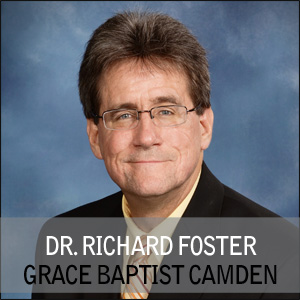
Richard Foster, Grace Baptist Church

Published by the Camden News in Religious Reflections April 12, 2013
Leave a comment

Filed under religion

What is Your Next Step of Faith?

Noah was commended for being righteous, blameless in his generation, and for walking with God (Genesis 6:9). Walking with God seems to be the climax of the list. Not only did he live an upright life, not only was he a bright spot in a corrupt and wicked generation, but he actually walked with the Living God, a very high compliment in Scripture. But what does it mean to walk with God?

The word walk is used in the Bible for a person’s lifestyle. Some of our newer translations simply use the word live. For instance, Galatians 5:16 is sometimes rendered: Live by the Spirit (Galatians 5:16). A literal translation is: Walk by the Spirit. By using the picture of walking we get the idea that our spiritual life is going somewhere. So we can ask: What is the next step in following the Lord?

To live a godly life in an ungodly world was only one step in Noah’s spiritual life. God challenged him to take the next step: to build an ark. If Noah was trying to blend in and stay out of sight, he was in for a surprise. You cannot hide a 450-foot-long, 75-foot-wide, 45-foot-high ark. In order to walk with God, Noah had to do something that would make his faith very public, very noticeable.

Building the ark must have taken many years of hard work. Surely Noah got used to the routine. In addition to all the things he did before, he now had to find time for building that massive floating box. But all the things he did before were still there, providing some continuity. Then, when the ark was finally finished, it was time to take another step of faith, the next step in walking with God.

God instructed Noah to enter the ark with his family. Once inside, God himself closed the door. It’s one thing to build the ark, but it is something else to go inside and leave the past behind. Everything changed for Noah when he took his family inside that ark. God unleashed the flood, and with it his judgment on a wicked and rebellious world. Noah’s life would never be the same.

Noah understood that walking with God meant leaving his comfort zone and following the Lord into the unknown. He knew that he could trust God, even though it meant losing what was familiar to him. Trying to stay in the previous stage of faith would have been a disaster for Noah. He was not called to build arks, but to build one ark and to entrust himself and his family to that one ark. He had to find the courage to take the next step.

What is the next step of faith for me? for you? If we are going to walk with God, then we will be called on by God to move forward one step at a time, not to stand still. Occasionally we will face a step that requires great faith on our part because it means leaving familiar things behind and going on to something new and unprecedented.

Perhaps the Lord is calling you to take the next step of faith by doing something new. To stand still would be like Noah refusing to enter the ark, or to leave it when the time came. Obedience will keep your spiritual life healthy and vital. Jesus is calling us to follow him, one step at a time, hand to the plow, not looking back, and fit for service in the Kingdom of God (Luke 9:62).

May God’s Spirit inspire and enable us to follow Jesus every step of the way,

Brother Richard Foster

Leave a comment

Filed under religion

King David’s Support

David was an extraordinary man. He was a mighty warrior, a wise king, a gifted musician and poet. As a king in the ancient Near East some 3,000 years ago, he was in a position of almost unquestioned power and authority. David united the people of Israel into a strong and successful nation, subduing all his enemies. He captured Jerusalem and built his capital there, forging a well-deserved reputation as an effective leader.

David’s successes could very easily have persuaded him that he was invincible. Such power and notoriety could have resulted in a man who was proud to the point of arrogance. But in addition to David’s military might, political ability, and musical talent, he was a deeply spiritual man. David trusted the God of heaven and earth implicitly. In fact, it was his trust in the LORD that inspired him to fight and defeat the giant Goliath when David was still a lad.

David is credited with writing many of the Psalms in our Old Testament. In Psalm 18, he expressed his deep love for the LORD in passionate worship. David recognized that the LORD was his strength, his security, his song, and his salvation. In verse 18 he remembered that his enemies confronted him in a day of disaster, but the LORD was his support. David gave God credit for his victory.

In Psalm 18:6 David recounted how he cried out to the LORD when he was in distress. His response to distress is remarkable. When people are in distress they tend to reveal what their real support truly is. Under stress we discover what we really believe, what or whom we really trust. When serious stress hits, different people run to different things for support. Some people simply go into despair. Apparently they have no support at all.

When you are being pressed hard, where do you go for strength, security, and deliverance? What or who is your support? If a man as powerful, popular, smart, successful, and talented as King David needed the LORD for support, surely the rest of us do, too. David cried out to God, and as David recorded in Psalm 18:16, “He reached down from on high and took hold of me.” What better place to be than in the grip of God?

May Almighty God be our support in all that we do,

Brother Richard

Leave a comment

Filed under religion

Offended or Overjoyed?

It was a legal hearing to determine the charges against him.  The Roman commander had called for the Jewish ruling council to investigate Paul.  If the council was able to prove its charges against him, then the Roman commander would probably turn Paul over to them, and they would almost certainly execute him.

With his own life hanging in the balance, Paul stood to defend himself.  He started by claiming his innocence but the council refused to hear that.  What would he do?  What could he possibly say to a group that was so hostile toward him and bent on ending his life?  Here’s what he did say, “I am on trial because of my hope in the resurrection of the dead.” (See Acts 22:30-23:10)

For the Apostle Paul, everything he believed and everything he lived for came down to the resurrection.  The resurrected Jesus Christ had appeared to Paul on that road to Damascus and everything changed.  Since Jesus was really resurrected, then the resurrection became the most important thing in life.

Not everybody agreed with Paul about the importance of the resurrection.  Paul’s Gospel made many people angry but at the same time it brought great joy to many others.  The message of a resurrected Lord Jesus who is the only Savior sent from God still has the same effects today.  Some are offended that Jesus is presented as the only way to eternal life.  Others are overjoyed.

At Easter we make it a special point to emphasize this one great truth: Jesus was raised again so we will be, too.  Jesus said that a day is coming when all will be raised, the just and the unjust.  Those who did good will rise to live and those who practiced evil will rise to be judged (John 5:28-29).  We rejoice about the resurrection because Jesus himself is our guarantee of goodness.

May God’s Spirit lift you up and fill you with the joy of his salvation,

Brother Richard Foster

Leave a comment

Filed under religion

Podcast: You Cannot Hide Real Faith

Podcast: You Cannot Hide Real Faith

What does saving faith move us to do?
Dr. Richard Foster explains through Genesis 6:9-22.

Leave a comment

Filed under Podcasts

The Last Word

Jesus stood before Pilate.  A humble Jewish carpenter who had become an itinerant preacher was at the mercy of the powerful Roman governor.  Jesus stood bound by the chains of disgrace and Pilate stood adorned in the robes of honor.  The preacher was in submission and the statesman was in control—so it seemed.

Jesus had made some powerful enemies among the religious leaders in the city.  Pilate had forged some powerful connections in the ranks of the ruling elite.  Jesus apparently represented nothing more than a small spiritual movement confined to a relatively limited region, a movement that was embraced by just a handful of followers.  Pilate represented the mighty Empire that ruled much of the civilized world.

A lowly preacher was delivered into the hands of a powerful government official.  History thrust these two men against each other, but their conflict appeared to be one-sided.  As events unfolded that busy day in Jerusalem, anyone watching would have given the victory to Pilate and his Empire.  Before the day was done, Jesus had been brutally executed and Pilate still occupied his seat of authority.

Despite his honored status and impressive authority, despite the magnificence of his culture with all its wise laws and brilliant architecture and military might, Pilate and his Roman Empire would fade from its exalted place, left behind by the unstoppable advances of history.  On that Friday morning he seemed to be in command, but his power was not the last word.

Despite his public shame, his painful wounds, his broken body, his spilled blood, and the heavy stone that sealed his corpse in a tomb, Jesus would rise up and give birth to a spiritual movement that would challenge the powers and authorities of this world for two millennia, a movement that continues to challenge the powers and authorities of this world today.  On that Friday morning he seemed to be defeated, but his crucifixion was not the last word.

The turning point was Jesus’ resurrection.  Jesus, it turns out, was not simply a lowly preacher who left behind the life of a carpenter in Nazareth.  Jesus was, and is, the Leader of God’s Kingdom.  His resurrection firmly establishes his vital place in time and eternity.  All kingdoms and empires, all powers and authorities, every leader and every ruler, will not only step aside, but they will bend the knee and they will confess the supremacy of the One Lord sent by God: Jesus Christ the resurrected Savior.

Jesus’ resurrection makes everything clear.  Now we know which kingdom will finally be victorious.  Now we know which kingdom to support and to serve.  Now we know, despite any appearances in the meantime, that citizens of God’s Kingdom will share the ultimate victory for all of eternity.  Now we know that our participation in Christ’s Kingdom, no matter what the cost, is not in vain.

Because of Jesus’ resurrection, we should never lose heart, despite the apparent victories of the powers and authorities in this world.  Because of Jesus’ resurrection we know that all such victories are temporary, fleeting shadows in this passing age.  Because of Jesus’ resurrection we should gather on every Lord’s Day and worship, but especially on Easter.

Easter reminds us that Jesus Christ is the Living Word, the Word of Truth, and the Last Word—we need not wait for another Word from God, Christ is the fullest revelation of God’s glory.  The chains that bound him and the nails that pierced him have long since crumbled.  Jesus the Crucified and Risen One is seated at the right hand of God in glory!  What could possibly keep us from praising him?

May God’s Spirit fill us with the power and the joy of Christ’s resurrection,

Brother Richard Foster, Pastor
Grace Baptist Church, Camden, AR

Leave a comment

Filed under religion

The Very Words of God

In Psalm 19, we read that the Lord’s law revives the soul and his precepts make glad the heart (Psalm 19:7-8).  These phrases might sound a bit strange to our twenty-first-century ears.  How can laws and principles bring gladness to our hearts?  How can instructions and precepts revive our souls?

Before writing about the joy of the Lord’s precepts, the psalmist first marvels at the greatness of God’s creation.  The breathtaking beauty and unmistakable design of the cosmos point to a powerful and wise Maker.  Seeing the fingerprint of God creates a desire to know the mind of God.  Nature, however, is silent about God’s personal traits.  How can we see beyond the handiwork of God and hear his thoughts, know his mind?

After noting the glory of God in the sky, the psalmist turns to the perfection of God’s laws and precepts.  When the psalmist writes about the Lord’s laws and precepts, he is referring to God’s written Word: the Bible.  In the Bible we read the thoughts and plans of the Maker who called into existence the starry host and who calls them each by name.  From the Scriptures we learn how we can know this mighty Lord of heaven and earth, and how we can experience his blessing.

Most of us have owned a Bible since we were very young.  In fact, most of us have several copies of the Bible, and we can buy as many as we want.  We have grown up being taught what God has revealed about his thoughts and plans.  As a result, we might take for granted what an honor it is to have in our possession the very words of God, who manages spiral galaxies and forms subatomic particles.

What if we started out life without the Bible?  What if we lived for decades in awe of God’s greatness, seeing his handiwork daily, wondering if we could know his thoughts, wanting to find out if this magnificent God can be known?  What if we were in our thirties or forties before we heard Scripture or held a Bible in our hands?  Perhaps then we would experience the reviving of spirit and gladness of heart that the psalmist describes.

The psalmist looked at the sky and marveled at the handiwork of God.  As a result, he expressed a great appreciation for God’s Word.  Greater appreciation for the majesty of the physical world in which we live leads to a greater appreciation for the honor of knowing the thoughts and the plans of the one who made and manages the universe.  Let us never forget how blessed we are to have the very words of God.

May God’s Holy Spirit fill us with unending gratitude for his perfect Word,

Brother Richard

Leave a comment

Filed under religion

Podcast: The Power Of Human Sexuality

The Power of Human SexualityRichard-pod-300

Leave a comment

Filed under Podcasts

Podcast: Why Live For God?

Leave a comment

Filed under Podcasts

Noah’s Proclamation

Noah must have been one of the most tenacious and single-minded people who ever walked the face of the earth. He lived at a time when God was all but forgotten; a time when wicked living was standard operating procedure everywhere. But Noah stood strong for what was right even though the whole world was against him. He was willing to speak the truth in a world that did not want to hear. Surely his life would have been easier had he simply kept his mouth shut, but he did not.

And Noah did more than speak the truth; he lived the truth. Noah’s faith was so strong that he not only worked to support his family, he also worked to build an ark according to God’s design and for God’s purpose. He was devoted to doing work that would please God and lead others to faith and deliverance.

So Noah proclaimed righteousness in a world of wickedness and he built an ark for safety in the day of God’s judgment. He did all this despite the apathy of his generation. How did he do it? How did Noah stand for truth and build for God under such difficult conditions?

One reason that Noah had such a strong faith was his conviction that he had received a word from the Lord. He had no app on his iPhone with multiple translations of the Bible and word-search capabilities. He had no TV preachers, Sunday school teachers, or conference speakers, but he knew that God had spoken to him.

And Noah was willing to live his life based on the word which he had received from God. Even though God’s word to Noah meant that he would be going against the strong tide of public opinion, Noah obeyed. Pleasing God was more important to Noah than getting along with everyone else.

Like Noah, we have a word from the Lord. Like Noah, we are called to speak for God and to build for God in a world that is unfriendly to God. And like Noah, we can choose to be silent and get along with the world, or we can decide to speak up and get the approval of our Lord.

Noah went through some tough times, but God was with him. In the end he experienced a great victory. God is calling us to proclaim his truth and to build his kingdom in a rebellious world. Going against the flow is not easy, but our Lord promises to be with us. And he promises that we will share in his ultimate triumph.

May the love of Christ compel us to say and do all that our Lord desires,

Brother Richard Foster, Pastor
Grace Baptist Church, Camden, AR

Leave a comment

Filed under Evangelism, religion, Service